

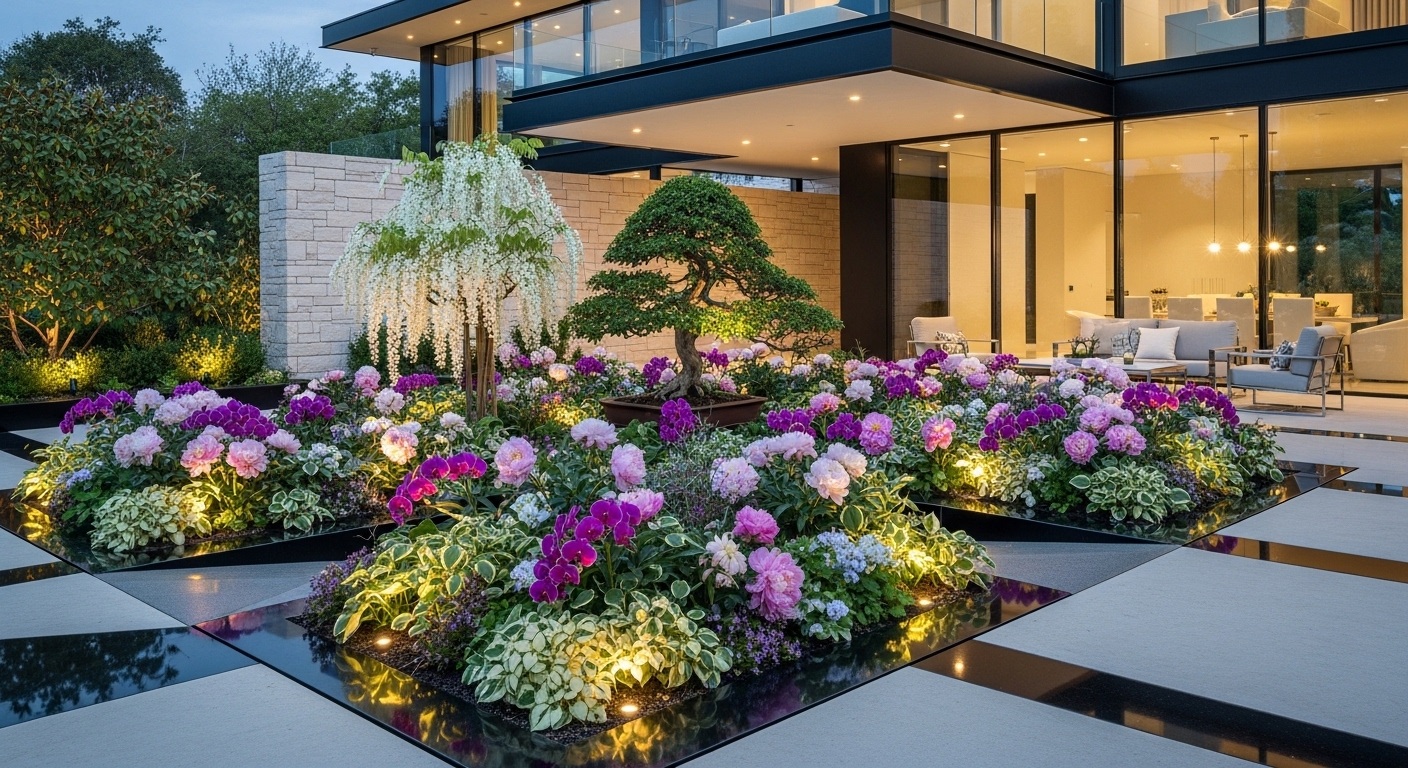
Walk through any upscale Houston neighborhood — River Oaks, Memorial, Sugar Land's Telfair, or The Woodlands' Creekside — and you'll notice that the best-looking flower beds aren't necessarily the most complicated or the most expensive. They're the most intentional. Clean lines, cohesive plant choices, and consistent maintenance create the kind of polished look that makes a home stand out, and most of those principles cost very little to implement.
Whether you're preparing your Houston home for sale, trying to keep up with the neighbors, or just want a yard you're proud of, these are the techniques that work best in Houston's climate.
Nothing transforms a flower bed faster or more affordably than a sharp, clean edge. A bed with a crisp border immediately looks more professional, more intentional, and more expensive — regardless of what's planted inside it. Use a flat spade or a dedicated edging tool to cut a clean line, then install steel edging, stone, or brick to hold it permanently.
Smooth curves look naturally elegant in Houston residential landscapes. Avoid tight, choppy zigzags — broad, sweeping curves read as designed, while irregular lines read as accidental. Once you define that edge, everything inside the bed looks better instantly.
One of the most common mistakes Houston homeowners make is buying one of every plant that looks good at the garden center in spring. The result is a flower bed that looks like a plant swap — busy, colorful in a chaotic way, and somehow not beautiful despite all the effort.
The fix is counterintuitive: use fewer plant varieties, planted in larger groups. Three clusters of salvia, five society garlic plants, seven liriope along the front edge. That kind of repetition creates rhythm. The bed looks designed, not collected. Stick to two or three main plant types and a coordinated color palette, and the whole yard instantly looks more expensive.
Flat beds look flat. An expensive-looking flower bed has dimension — you can see every plant, and the whole thing has a sense of architecture to it. Achieve this by planting in layers: tall structural plants or shrubs toward the back (nearest the house or fence), mid-height flowering plants in the middle zone, and low edging plants or groundcovers at the front.
For Houston, a classic high-end layering combination might be: loropetalum or dwarf yaupon holly in the back, knockout roses or salvia in the middle, and liriope or society garlic as the front edge. That combination looks polished, thrives in Houston's heat, and stays interesting through most of the year.
Fresh mulch might be the single highest-ROI improvement you can make to a Houston flower bed. A 2–3 inch layer of dark brown hardwood mulch makes every plant look healthier, every color brighter, and every edge crisper. It also suppresses weeds, retains moisture in the summer heat, and protects roots — so it's doing real work while it looks good.
The key is consistency: use the same mulch type and color throughout all of your beds. A yard where one bed has red dyed mulch, another has pine bark, and another has gravel looks disjointed. One unified mulch choice across the whole yard creates cohesion that's immediately noticeable.
Expensive-looking landscapes always have a visual anchor — one element that the eye is drawn to. In a Houston flower bed, this might be a large decorative planter at the entry, a sculptural agave or sago palm as a centerpiece, a clipped standard rose, or a statement boulder surrounded by low plantings.
You don't need multiple focal points. One strong one is enough. Everything else in the bed should support it rather than compete with it. This principle — hierarchy in design — is what separates beds that look curated from beds that look random.
A flower bed that looks amazing in April but sad in August doesn't serve you well in Houston, where summers are long and people are out and about constantly. The goal is to choose plants that maintain their appeal through as much of the year as possible.
This means anchoring the bed with evergreen structure (dwarf yaupon holly, Indian hawthorn, loropetalum) and filling in with long-blooming performers like lantana, salvia, pentas, and knockout roses. These plants keep going through Houston's brutal summers without constant replanting or special care.
The most expensive-looking flower bed in Houston will look cheap within a few weeks if it's not maintained. Trim dead growth, deadhead spent blooms, re-edge after mowing, and top off mulch when it gets thin. During Houston's long growing season, most plants need attention every 2–3 weeks to stay looking their best.
This is where professional maintenance makes a real difference. A well-installed bed that's professionally maintained always looks better than a more elaborate bed that's left to its own devices.
We design flower beds for Houston homeowners who want that polished, high-end look without the guesswork. From initial design to full installation to ongoing maintenance, we handle everything. Our work is visible across Houston, Katy, Sugar Land, Pearland, The Woodlands, Cypress, and surrounding areas.
Contact us today for a free consultation and let's build something your neighbors will notice.